AI Resume Writing: How to Use AI to Write a Better Resume
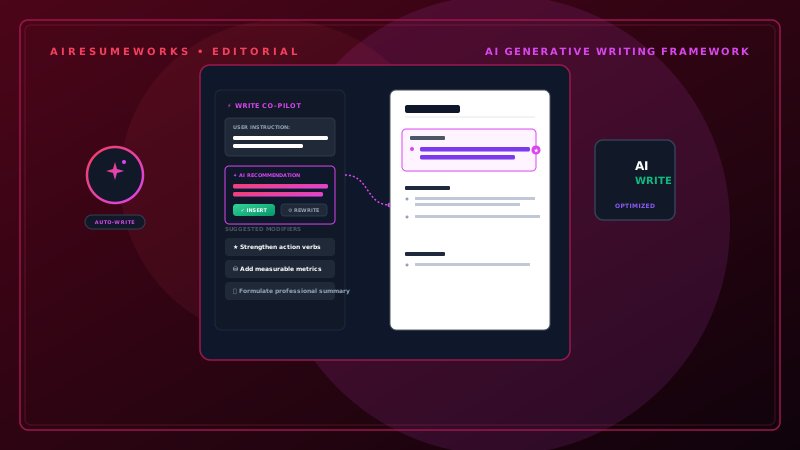
Artificial intelligence can make resume writing faster and easier, but it works best when you use it as a writing and editing assistant rather than allowing it to create your entire resume without your input.
AI resume tools can help you organize your experience, improve weak wording, identify relevant skills, tailor your resume to a job description, and create stronger bullet points. However, the information in the final resume should always be based on your real education, experience, skills, and accomplishments.
What Is AI Resume Writing?
AI resume writing uses artificial intelligence to help create, improve, or customize resume content. Depending on the tool, you may be able to use AI to:
- Write a professional summary
- Improve resume bullet points
- Identify relevant skills
- Match a resume to a job description
- Suggest keywords
- Rewrite unclear sentences
- Improve grammar and spelling
- Create accomplishment-focused statements
- Identify missing information
- Analyze ATS compatibility
- Create different versions of a resume
The quality of the result depends heavily on the information you provide.
Start With Your Real Information
Before asking AI to write your resume, gather your career information. Include:
Previous employers
Job titles
Employment dates
Responsibilities
Accomplishments
Skills
Education
Certifications
Projects
Volunteer experience
Relevant awards
Professional training
The more useful information you provide, the easier it is for AI to create accurate resume content. Do not expect AI to know your career history automatically.
Give AI Specific Information
A vague request such as:
Write me a resume. will usually produce generic content. A more useful request includes information about your experience and the position you want. For example, provide:
- Your current or previous job
- Your responsibilities
- Your accomplishments
- Your skills
- The type of position you want
- The job description
This gives the AI enough context to create more relevant content.
Use AI to Write Your Professional Summary
A professional summary is one area where AI can save time. You can provide your actual experience and ask AI to turn it into a concise summary. For example, you might provide:
8 years of customer service experience, managed customer accounts, trained new employees, handled complaints, and regularly exceeded monthly service goals.
AI can use that information to create a polished professional summary. However, review the result carefully to make sure it does not introduce claims that you did not provide.
Use AI to Improve Resume Bullet Points
AI can be particularly useful for improving weak bullet points. For example:
Answered customer calls. could potentially become:
Handled high-volume customer calls, resolved service questions, and provided timely solutions. The improved version communicates more information. If you have a measurable accomplishment, include it.
For example:
Handled an average of 60 customer calls per day while maintaining a high customer satisfaction rating. Numbers should always be accurate.
Turn Responsibilities Into Accomplishments
Many resumes contain long lists of duties. AI can help you identify opportunities to present those duties more effectively. Instead of:
Responsible for inventory. you might provide AI with more information:
Checked inventory every week, updated records, noticed shortages, and worked with suppliers to order replacement products. AI can then help turn that information into a stronger resume bullet.
The important part is that you provide the facts.
Use AI to Find Resume Keywords
AI can compare your resume with a job description and identify terminology that may be relevant. For example, a job posting may repeatedly mention:
- Project management
- Budget management
- Microsoft Excel
- Vendor coordination
- Reporting
If you genuinely have those skills, AI can help you make sure they are clearly represented on your resume. Do not add keywords simply because they appear in the job description.
Tailor Your Resume With AI
One of the most useful applications of AI resume writing is tailoring. Instead of using exactly the same resume for every position, you can provide your resume and a job description and ask AI to identify areas that should be emphasized.
AI can help determine:
Which skills are most relevant Which accomplishments should receive more attention Which keywords appear important Which sections could be improved Which experience is most closely related to the position
You can then make the appropriate changes to your resume.
Do Not Let AI Invent Experience
This is one of the most important rules of AI resume writing. AI may sometimes produce impressive-sounding statements that are not supported by your information.
For example, if you tell AI:
I managed customer accounts. It should not turn that into:
Managed a portfolio of 250 enterprise accounts and increased retention by 35%. Unless those numbers and responsibilities are actually true, they should not appear on your resume.
Never allow AI to invent:
Employers
Job titles
Degrees
Certifications
Skills
Responsibilities
Accomplishments
Statistics
Promotions
Awards
An impressive false statement can create serious problems during an interview or background check. Use AI to Improve, Not Replace, Your Judgment AI can suggest better wording, but you remain responsible for the final document.
Read every sentence. Ask:
Is this accurate? Did I actually do this? Is this describing my experience? Are the numbers correct? Does this sound like my actual level of responsibility? Is the wording appropriate for the position?
If the answer is no, change or remove the statement.
Use the Job Description as a Guide
AI can help you understand what an employer is looking for. Read the job description carefully and identify:
- Required skills
- Preferred skills
- Responsibilities
- Education requirements
- Certifications
- Software
- Experience requirements
- Important terminology
Then compare those requirements with your background. AI can help organize the comparison, but you should make the final decision about what belongs on your resume.
AI Can Help With ATS Optimization
Applicant tracking systems can analyze resumes for information such as keywords, skills, job titles, and experience. AI tools can help identify possible ATS problems.
For example, an AI resume tool might identify that a job description emphasizes "project management," while your resume uses only "project coordination."
If both terms accurately describe your experience, you may be able to clarify that connection. AI can also help identify overly complicated wording or missing information.
However, an AI score is not a guarantee that an employer will select your resume.
Keep the Resume Easy to Read
AI can sometimes make writing sound overly formal. A resume does not need complicated language to appear professional. For example:
Utilized strategic methodologies to facilitate the optimization of customer engagement processes. may sound impressive but can be less clear than:
Improved customer service processes to increase response speed and customer satisfaction. Clear writing is usually more useful than complicated wording.
Use AI to Remove Repetition
If several bullet points begin with the same words or describe similar responsibilities, AI can help identify repetition. For example:
Managed customer accounts. Managed customer complaints. Managed customer records. You may be able to vary the wording while keeping the information accurate:
Maintained customer accounts and records. Resolved customer complaints and service issues. Updated customer information and documentation. The goal is not to use different words simply for variety. The wording should accurately describe different responsibilities.
Use AI for Grammar and Spelling
AI can also function as a proofreading assistant. Ask it to identify:
- Spelling errors
- Grammar problems
- Awkward sentences
- Inconsistent verb tense
- Repeated words
- Formatting inconsistencies
You should still review the suggestions before accepting them.
AI Resume Writing for Career Changers
Career changers can use AI to identify transferable skills. For example, someone moving from retail management into office administration may have experience with:
- Scheduling
- Customer communication
- Employee training
- Inventory
- Reporting
- Problem solving
AI can help translate those experiences into language that is relevant to administrative positions. The underlying experience does not change. AI simply helps present it in a way that connects with the new career direction.
AI Resume Writing for People With No Experience
AI can also help students and first-time job seekers organize limited experience. Relevant information might include:
Education
School projects
Internships
Volunteer work
Part-time jobs
Certifications
Technical skills
Leadership activities
A person does not need years of professional employment before creating a useful resume. AI can help identify transferable skills and organize the available information into a professional structure.
Use AI to Create Multiple Resume Versions
If you apply for different types of jobs, you may benefit from having several targeted versions of your resume. For example:
Customer Service Resume
Focuses on:
- Customer relationships
- Communication
- Problem solving
- Service
- Retention
Administrative Resume
Focuses on:
- Organization
- Scheduling
- Data entry
- Records
- Office software
Management Resume
Focuses on:
- Leadership
- Team development
- Performance
- Operations
- Planning
AI can help you adapt your master resume for each type of position without starting from zero.
Keep a Master Resume
A master resume contains your complete professional information. It can include accomplishments that are not relevant to every job application. When applying for a particular position, you can use your master resume as the starting point and remove or reduce information that is less relevant.
This approach makes AI-assisted resume writing much more efficient.
Protect Your Personal Information
Be careful about the information you enter into an AI resume tool. Avoid unnecessarily providing sensitive information such as:
- Social Security numbers
- Bank account information
- Passwords
- Government identification numbers
- Other highly sensitive personal data
Before using an AI resume service, review its privacy policy and understand how it handles information you provide.
Don't Automatically Trust AI Resume Scores
Some AI resume tools provide scores such as:
82/100
or:
95% ATS Match
These numbers can be useful as general feedback, but there is no universal resume scoring system used by every employer. Different tools can evaluate resumes differently.
A higher score does not guarantee an interview. Use scores as one source of feedback rather than treating them as the final judgment on your resume.
A Simple AI Resume Writing Workflow
You can use AI without turning the process into something complicated. Step 1: Gather your real career information. Step 2: Create a strong master resume.
Step 3: Find a job you want to apply for. Step 4: Copy the job description. Step 5: Ask AI to compare your resume with the job description. Step 6: Review suggested keywords and skills.
Step 7: Improve relevant bullet points. Step 8: Adjust your professional summary. Step 9: Check ATS-friendly formatting. Step 10: Review every AI-generated statement for accuracy.
Step 11: Proofread the final resume. Step 12: Save the targeted version separately. This process can make resume customization much faster while keeping control of the final document.
Example of an AI-Assisted Resume Improvement
Suppose your original bullet says:
Worked with customers and helped solve problems. You provide additional information:
Worked at a busy retail store, handled customer complaints, helped customers find products, processed returns, and trained two new employees. AI could help turn that information into bullets such as:
Resolved customer concerns, processed returns, and assisted shoppers in a high-volume retail environment. Helped train two new employees on customer service procedures and store operations.
The AI is useful because it organizes and improves the wording. The facts still come from you.
Review the Final Resume as a Human Would
After using AI, stop thinking about keywords and scores for a moment and read the resume normally. Ask yourself:
Does this clearly explain who I am, what I have done, and why I am qualified for this position? If the resume sounds unnatural, repetitive, exaggerated, or overly complicated, simplify it.
The best AI-assisted resume is not the one with the most impressive language. It is the one that clearly and accurately communicates relevant qualifications.
AI can make resume writing considerably faster, particularly when you use it to improve wording, identify relevant keywords, tailor experience to a job description, and organize information. The strongest results come from combining AI assistance with accurate information and human judgment. Start with your real experience, use AI to improve how that experience is presented, and carefully review everything before sending the resume to an employer.