Best Resume Format for a Job: How to Choose the Right One
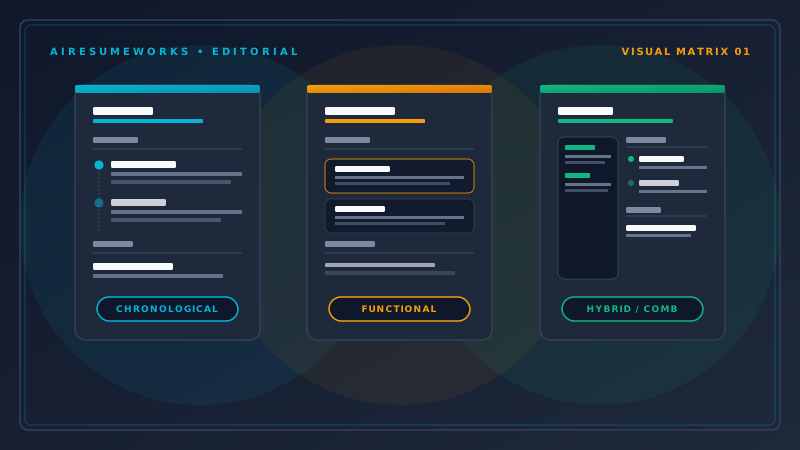
Choosing the right resume format is an important part of creating a strong job application. The format determines how your experience, skills, education, and accomplishments are organized on the page.
There is no single resume format that works for every job seeker. The best choice depends on your work history, career goals, experience level, and the position you are applying for.
For many job seekers, a reverse chronological resume is the most straightforward option. However, functional and combination formats can also be useful in certain situations.
The Three Main Resume Formats
The three most common resume formats are:
- Reverse chronological
- Functional
- Combination
Each one emphasizes different aspects of your background.
Reverse Chronological Resume
A reverse chronological resume emphasizes your work experience. Your most recent position appears first, followed by previous positions in reverse order.
For example:
- Marketing Manager
- ABC Company — 2023–Present
- Marketing Coordinator
- XYZ Company — 2020–2023
- Marketing Assistant
- Example Company — 2018–2020
This format makes your career progression easy to follow. It is particularly useful when your recent work experience is relevant to the position you want.
Functional Resume
A functional resume places more emphasis on skills and qualifications than on employment history. Instead of making your job history the primary focus, the resume may organize information around areas of expertise.
For example:
Project Management
- Coordinated multiple projects
- Managed project schedules
- Worked with cross-functional teams
Customer Service
- Resolved customer issues
- Managed customer accounts
- Handled high-volume inquiries
A functional format may be considered by someone with limited experience, career gaps, or a career history that does not directly relate to the position.
However, it can make your employment history less obvious, which may not be ideal for every job application.
Combination Resume
A combination resume combines elements of chronological and functional formats. It allows you to highlight important skills and accomplishments while still providing a detailed employment history.
This format can work well for experienced professionals who want to emphasize specialized skills without hiding their career progression.
Which Resume Format Is Best?
For many job seekers, the reverse chronological format is the best starting point. It is straightforward, familiar, and makes it easy for employers to understand your career history.
Consider this format if:
- You have relevant work experience
- Your career history is relatively consistent
- Your recent positions relate to the job
- You want to demonstrate career progression
A different format may make more sense if your employment history is unusual or your transferable skills are more important than your job titles.
Best Resume Format for Experienced Professionals
Experienced professionals often benefit from a reverse chronological format. Your most recent experience can demonstrate your current skills and level of responsibility.
Focus on:
- Recent positions
- Major accomplishments
- Leadership responsibilities
- Relevant skills
- Career progression
- Industry-specific qualifications
You do not need to give equal space to every position you have ever held. Older experience can usually be presented more briefly when it is less relevant to your current career goals.
Best Resume Format for Recent Graduates
Recent graduates may have limited professional experience. A reverse chronological format can still work, but education, internships, projects, volunteer work, and relevant skills may need more attention.
For example, your resume might be organized as:
Contact Information
Professional Summary
Education
Relevant Experience
Projects
Skills
The exact order can vary depending on which qualifications are strongest. If your degree and academic experience are highly relevant to the position, education may deserve a prominent position.
Best Resume Format for Career Changers
Career changers may face a different challenge. Your previous job titles may not directly correspond to the position you want. A combination format can sometimes help because it allows you to emphasize transferable skills before presenting your employment history.
For example, someone moving from retail management into office administration might emphasize:
- Team management
- Scheduling
- Customer communication
- Inventory management
- Administrative responsibilities
- Problem solving
The work history can then provide evidence supporting those skills. The goal is to show employers how your existing experience relates to your new career direction.
Best Resume Format for Employment Gaps
Employment gaps do not automatically require a functional resume. In many cases, a straightforward chronological resume can still be used. Focus on presenting your experience accurately and emphasizing your qualifications.
If you gained useful experience during an employment gap, you may be able to include relevant activities such as:
Freelance work
Contract work
Volunteer work
Education
Professional training
Independent projects
Do not attempt to hide employment gaps by creating a misleading work history. Accuracy is more important than trying to make your career history appear perfectly continuous.
Resume Format for People With Limited Experience
If you have limited professional experience, you can emphasize other relevant qualifications. These may include:
Education
Internships
Volunteer experience
Projects
Certifications
Skills
Part-time work
Relevant extracurricular activities
A functional or combination format may sometimes help, but a clean chronological resume can also work well when the information is organized effectively.
The important thing is to avoid adding unnecessary information simply to make the resume longer.
Resume Format for ATS Applications
If you are submitting your resume through an online application system, keep the format straightforward. Applicant Tracking Systems may scan resumes for information such as:
Job titles
Skills
Keywords
Education
Work experience
Certifications
A simple layout can make the information easier to identify. Consider using:
- Standard section headings
- Readable fonts
- Clear text
- Consistent formatting
- Straightforward layouts
Avoid excessive:
- Graphics
- Images
- Charts
- Skill bars
- Decorative icons
- Complicated formatting
A resume should be easy for both software and people to understand.
Should You Use a Two-Column Resume?
Two-column resumes can provide an attractive layout, but they are not always necessary. A two-column design might place skills and contact information in one column and work experience in another.
This can make efficient use of space, but a single-column format is often simpler and more straightforward. If ATS compatibility is a major concern, a clean single-column layout can be a practical choice.
How Long Should Your Resume Be?
Resume length depends on your experience and the amount of relevant information you need to present. A one-page resume may be appropriate for:
Students Recent graduates People with limited experience Professionals with relatively short career histories A two-page resume may be appropriate for:
Experienced professionals Managers Executives Candidates with extensive relevant accomplishments Do not remove important information simply to force an experienced candidate's resume onto one page.
At the same time, do not add unnecessary information simply to make a resume longer.
Resume Formatting Basics
Regardless of which format you choose, several basic formatting principles apply.
Use Readable Fonts
Choose a professional font that is easy to read. Avoid overly decorative typefaces.
Maintain Consistent Spacing
Use consistent spacing between:
- Sections
- Jobs
- Bullet points
- Headings
- Use Clear Headings
Standard headings such as:
Work Experience
Education
Skills
Certifications
make the resume easy to navigate.
Use Bullet Points
Bullet points can make work experience easier to scan. Start bullets with strong action verbs when appropriate. Examples include:
- Managed
- Created
- Developed
- Improved
- Coordinated
- Increased
- Reduced
- Implemented
- Organized
- Keep Design Elements Simple
A professional resume generally does not require extensive graphics or decorative elements. Your experience and qualifications should remain the focus.
- Common Resume Format Mistakes
- ❌ Choosing a Format That Hides Your Experience
If your work history is a major strength, don't use a format that makes it difficult to understand your career progression.
❌ Using an Overly Complicated Design
A complicated layout can make the resume difficult to read.
❌ Making Everything the Same Size
Headings should be visually distinct from body text.
❌ Using Too Many Colors
Multiple colors can distract from the content.
❌ Shrinking the Font to Fit More Information
If the resume is too long, consider removing unnecessary information instead.
❌ Using a Different Format for Every Application
You may need to tailor the content for different jobs, but constantly changing the basic structure can create unnecessary work.
How to Choose Your Resume Format
Use the following questions to determine which format may work best.
Do you have relevant and relatively consistent work experience?
A reverse chronological format is likely a good choice.
Are your transferable skills more important than your job titles?
Consider a combination format.
Do you have limited experience?
Focus on education, skills, projects, internships, and other relevant qualifications.
Are you changing careers?
A combination format may help emphasize transferable skills.
Are you applying through an ATS?
Prioritize a simple, readable layout with standard headings.
Resume Format Checklist
Before choosing a format, make sure it:
✓ Clearly presents your experience ✓ Highlights relevant qualifications ✓ Is easy to read ✓ Uses consistent formatting ✓ Works for your career level ✓ Fits the type of position you want ✓ Uses relevant keywords ✓ Avoids unnecessary design elements ✓ Can be easily updated for different applications
The best resume format is the one that makes your most relevant qualifications easy to understand. For many job seekers, a reverse chronological format provides the clearest presentation of their experience. Career changers, people with limited experience, and candidates with unusual career histories may benefit from a combination or other alternative format.
Whatever format you choose, keep the design clean, make your accomplishments easy to find, and tailor the content to the position you are pursuing.