How to Match Your Resume to a Job Description
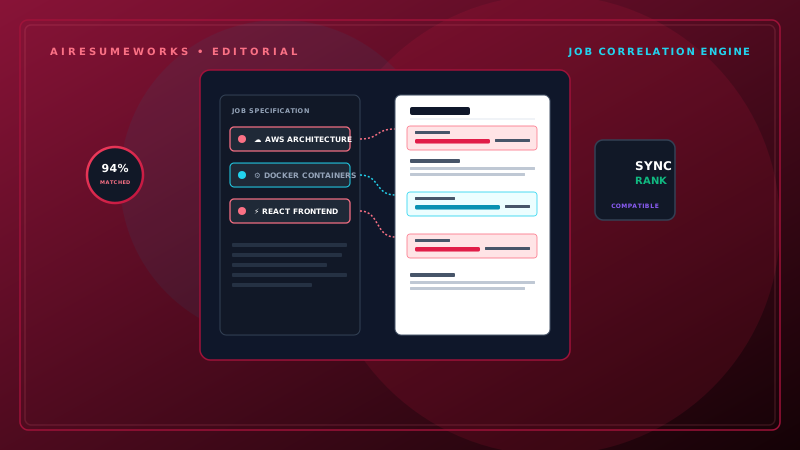
Matching your resume to a specific job description is one of the most effective ways to improve your chances of getting noticed by employers and applicant tracking systems (ATS). A strong resume should not be identical for every job application. Instead, it should be adjusted to reflect the requirements, skills, terminology, and priorities of the position you want.
This does not mean rewriting your entire resume from scratch every time you apply for a job. A better approach is to maintain a strong master resume and create targeted versions for the positions that interest you most.
Why Matching Your Resume Matters
Employers often receive many applications for a single position. An ATS may scan resumes before a recruiter reviews them, looking for information that relates to the job description.
If your resume contains relevant skills and terminology, it may have a better chance of making it through the initial screening process. For example, suppose a job description asks for:
- Customer relationship management
- Salesforce
- Account management
- Sales reporting
- Client retention
If your resume says only:
Worked with customers and helped increase sales. You may have relevant experience, but your resume does not clearly communicate that connection. If those skills accurately describe your background, a stronger version might be:
Managed customer accounts using Salesforce, monitored sales activity, prepared reports, and supported client retention efforts. The second version makes the connection between your experience and the employer's requirements much clearer.
Start With the Job Description
Before changing your resume, read the entire job description carefully. Do not focus only on the list of required skills. Look at the complete posting and identify:
- Required qualifications
- Preferred qualifications
- Technical skills
- Soft skills
- Job responsibilities
- Software or tools
- Certifications
- Industry terminology
- Education requirements
- Experience requirements
- Important phrases that appear repeatedly
Create a simple list of the most important requirements. For example:
Job requirements
- Project management
- Microsoft Excel
- Budget tracking
- Vendor coordination
- Team leadership
- Reporting
- Five years of experience
You can then compare that list with your existing resume.
Separate Required and Preferred Qualifications
Job descriptions often contain both required and preferred qualifications. Required qualifications deserve the most attention because they usually represent the employer's minimum expectations.
Preferred qualifications can still be valuable, particularly when several candidates have similar backgrounds. Organize the requirements into two groups:
Required
- Project management
- Budget management
- Excel
- Team coordination
Preferred
- PMP certification
- Experience with Jira
- Industry experience
This makes it easier to determine which qualifications should receive the most emphasis on your resume.
Look for Keywords in the Job Description
Keywords are words and phrases that describe the skills, qualifications, responsibilities, tools, and experience an employer is seeking. For example, a marketing position might repeatedly mention:
- Digital marketing
- SEO
- Google Analytics
- Content strategy
- Email marketing
- Campaign management
If you have legitimate experience with these areas, make sure your resume communicates that experience clearly. Use the terminology naturally rather than repeating keywords unnecessarily.
Keyword stuffing can make a resume difficult to read and does not create a stronger application.
Match the Language When It Is Accurate
Different employers may use different terminology for similar responsibilities. For example, your resume might say:
Managed customer accounts. The job description might say:
Managed client relationships. If both descriptions accurately represent your experience, you can use the employer's terminology when tailoring your resume.
The goal is not to copy the job posting. The goal is to make it easy for the employer to recognize that your experience is relevant.
Tailor Your Professional Summary
Your professional summary is one of the easiest sections to customize. A generic summary might say:
Experienced professional with strong communication, organizational, and problem-solving skills. That description could apply to thousands of applicants.
A targeted summary could be more specific:
Customer service professional with seven years of experience managing client relationships, resolving customer issues, and supporting account retention in high-volume environments.
The targeted version immediately communicates relevant experience. Only include qualifications you actually possess.
Adjust Your Skills Section
Your skills section should reflect the requirements of the position. Start with your complete skills list, then select the skills that are most relevant to the particular job.
For example, you may have 20 legitimate skills in your master resume. A particular job might emphasize:
- Microsoft Excel
- Data analysis
- Reporting
- Inventory management
- Vendor coordination
Those skills should receive greater visibility when applying for that position. Do not add a skill simply because it appears in the job description. If you have never used a particular software program, do not list it just to improve keyword matching.
Tailor Your Work Experience
Your work experience is usually the most important section to customize. Look at each position on your resume and identify responsibilities or accomplishments that relate directly to the target job.
Suppose you are applying for a management position. Your original bullet might say:
Helped employees with daily tasks. A more targeted version, if accurate, could be:
Coordinated daily activities for a team of employees and helped maintain workflow, productivity, and customer service standards. The second version provides more information about leadership and coordination.
Focus on Accomplishments
Whenever possible, emphasize what you accomplished rather than simply listing duties. Compare:
Responsible for handling customer complaints. With:
Resolved customer complaints and helped improve customer satisfaction by addressing issues quickly and consistently. Even better, if you have a real measurable result:
Resolved an average of 40 customer issues per day while maintaining a 95% customer satisfaction rating. Numbers can make accomplishments more concrete.
Never invent statistics simply because a job description emphasizes measurable results.
Use the Job Description to Prioritize Your Experience
You do not need to give every responsibility equal space. If a job description strongly emphasizes project management, experience related to project planning, coordination, deadlines, budgets, and teams should be easy to find.
Less relevant responsibilities can receive less attention. This does not mean deleting legitimate experience. It means giving the most relevant information greater visibility.
Match Job Titles Carefully
Job titles can sometimes create confusion. For example, your official title might have been:
Customer Service Specialist
But your actual responsibilities may have included account management. Do not change your official title to something inaccurate. Instead, you can make the responsibilities clear through your bullet points.
If an alternate title is genuinely useful for clarification, it should be presented honestly rather than making it appear that your official title was something it was not.
Match Your Resume to the ATS
An ATS may analyze the content and structure of your resume before a human sees it. A targeted resume should therefore remain easy for software to read.
Use:
- Standard section headings
- Clear job titles
- Conventional dates
- Simple bullet points
- Relevant keywords
- Readable fonts
- Consistent formatting
Avoid relying heavily on:
- Graphics
- Images
- Decorative elements
- Text inside images
- Unusual symbols
- Complicated layouts
- Excessive columns
A visually impressive resume is not useful if important information cannot be interpreted correctly.
Pay Attention to Required Qualifications
Some job descriptions contain requirements that should be addressed directly. For example:
Job posting:
- "Must have a bachelor's degree in accounting."
If you have the required degree, make sure your education section clearly shows it. If the employer requires a specific certification, license, or software skill that you possess, make it easy to find.
If you do not meet a mandatory requirement, do not attempt to disguise that fact by manipulating your resume.
Use AI to Help Compare Your Resume With a Job Description
AI tools can make the tailoring process faster. You can provide an AI resume tool with your resume and the job description and ask it to identify:
- Missing keywords
- Relevant skills
- Weak bullet points
- Areas that could be emphasized
- Experience that appears particularly relevant
- Possible ATS issues
AI can also help rewrite existing information for clarity. However, review every suggestion carefully. AI should help you present your real qualifications more effectively. It should not create qualifications you do not have.
Create a Master Resume
Maintaining a master resume can save considerable time. Your master resume can contain:
Complete work history
All relevant accomplishments
Skills
Certifications
Education
Projects
Volunteer experience
Awards
Other useful career information
You can then create targeted versions for different positions. For example:
Master Resume
Contains everything.
Marketing Resume
Emphasizes marketing, SEO, campaigns, analytics, and content.
Project Management Resume
Emphasizes project coordination, budgets, deadlines, teams, and reporting.
Customer Service Resume
Emphasizes customer relationships, problem solving, communication, and retention. This approach is much more efficient than creating every resume from scratch.
Do Not Copy the Job Description
Tailoring your resume does not mean copying sentences from the employer's posting. The employer wants to understand your experience, not read its own job description repeated back to them.
Use relevant terminology while describing your actual experience in your own words. For example, if the job description says:
"Responsible for coordinating cross-functional teams to deliver projects on schedule." Do not simply copy that sentence. Instead, if accurate, describe what you actually did:
Coordinated marketing, design, and sales teams to complete customer projects according to established deadlines. The information is targeted while still describing your own experience.
Check for Missing Keywords After Editing
Once you have tailored your resume, compare it with the job description again. Look for important requirements that you genuinely meet but may have overlooked.
You can create a simple checklist:
- Job requirement: Excel
- Resume: Included
- Job requirement: Project management
- Resume: Included
- Job requirement: Budget tracking
- Resume: Included
- Job requirement: Vendor coordination
- Resume: Not currently included
If you have legitimate vendor coordination experience, consider adding it. If you do not, leave it out.
Keep the Resume Readable
Tailoring should improve relevance without making the resume awkward. Avoid forcing keywords into every section. A recruiter should be able to read your resume naturally and quickly understand:
- What you do
- What experience you have
- What skills you bring
- Why your background fits the position
ATS optimization and human readability should work together.
Proofread the Final Version
After tailoring your resume, proofread the entire document. Check:
- Spelling
- Grammar
- Dates
- Job titles
- Company names
- Formatting
- Bullet points
- Contact information
- Keyword accuracy
- Consistency
Also make sure you did not accidentally leave information from another version of your resume. For example, if you maintain separate resumes for marketing and project management, make sure the final document does not contain an unrelated summary or skills section from the wrong version.
A Simple Resume-Tailoring Process
You can make the entire process repeatable. Step 1: Read the job description. Step 2: Identify required and preferred qualifications. Step 3: Highlight important keywords.
Step 4: Compare the requirements with your master resume. Step 5: Tailor your professional summary. Step 6: Adjust your skills section. Step 7: Reorder or strengthen relevant experience.
Step 8: Add relevant accomplishments and measurable results. Step 9: Check ATS-friendly formatting. Step 10: Proofread the final resume. Step 11: Compare it with the job description one more time.
This process can usually be done much faster once you have a strong master resume.
How Often Should You Tailor Your Resume?
You do not necessarily need a completely different resume for every application. If several positions have similar requirements, one targeted version may work for multiple applications.
However, when a job is particularly important or has significantly different requirements, spending additional time tailoring your resume can be worthwhile.
The more closely your resume reflects the position while remaining truthful, the easier it is for both ATS software and recruiters to understand your qualifications.
A strong resume is not simply a list of everything you have ever done. It is a focused presentation of the experience, skills, and accomplishments that are most relevant to the opportunity you want. By starting with a master resume and tailoring the most important sections to each job description, you can create applications that are more relevant without having to rebuild your resume from scratch every time.