How to Write a Nursing Resume: Examples and Tips
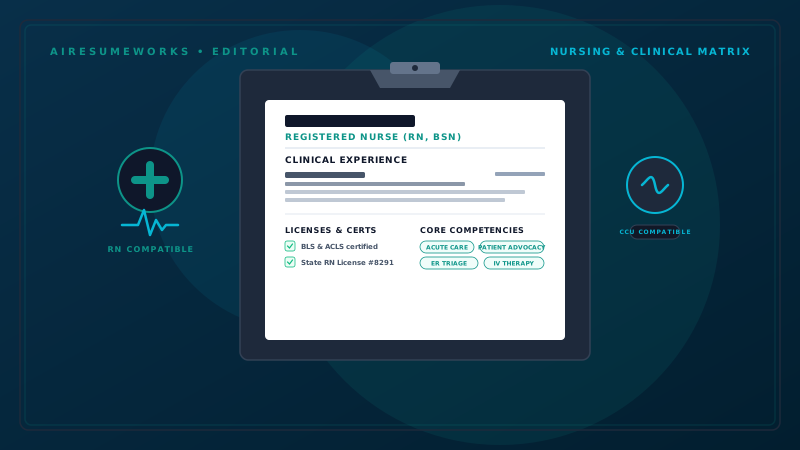
A nursing resume needs to communicate your education, clinical experience, professional skills, certifications, and accomplishments clearly. Whether you are applying for your first nursing position or moving to a new role, the resume should make it easy for an employer to understand your qualifications.
Nursing resumes can vary depending on experience and specialty. A recent nursing graduate will need to emphasize education and clinical experience, while an experienced nurse may focus more heavily on professional accomplishments, certifications, and specialized skills.
The goal is to create a resume that presents your nursing background clearly while matching the requirements of the position.
What Should a Nursing Resume Include?
A nursing resume commonly includes:
Contact information
Professional summary
Nursing experience
Education
Nursing license
Certifications
Clinical experience
Skills
Professional memberships
Relevant volunteer experience
You do not necessarily need every section. Include the information that supports the position you are applying for.
Start With Your Contact Information
Place your name and contact information near the top of the resume. Include:
- Full name
- Phone number
- Professional email address
- City and state
- LinkedIn profile, when relevant
Make sure your contact information is accurate. Your email address should also be professional and easy to recognize.
Write a Nursing Resume Summary
A professional summary provides a short introduction to your nursing background. It can mention:
- Years of nursing experience
- Nursing specialty
- Major clinical skills
- Certifications
- Areas of expertise
- Professional strengths
For example, an experienced registered nurse might highlight several years of patient care experience, a specialty such as emergency or critical care, and relevant certifications.
A recent graduate can focus on nursing education, clinical training, patient-care skills, and areas of interest. The summary should be specific rather than using generic statements such as "hardworking professional seeking a challenging opportunity."
Highlight Your Nursing Experience
Your nursing experience is one of the most important parts of your resume. For each position, include:
- Job title
- Employer
- Location
- Employment dates
- Relevant responsibilities
- Accomplishments
Use bullet points to make the information easy to scan. Instead of simply listing general responsibilities, describe the work you performed. For example:
Provided direct patient care and monitored patient conditions. Administered medications according to physician orders and established procedures. Collaborated with physicians and other healthcare professionals to coordinate patient care. Educated patients and families about treatment plans and follow-up care.
Whenever possible, include measurable information or specific accomplishments. For example, you might mention the number of patients typically managed during a shift, participation in quality-improvement programs, or responsibility for training other staff.
Only include information that accurately represents your experience.
Focus on Accomplishments
Responsibilities explain what you were expected to do. Accomplishments show the value you brought to the position. Compare:
Responsibility:
Assisted with patient care. More specific:
Provided direct patient care while monitoring vital signs, documenting changes, and communicating patient needs to the healthcare team. The second example gives the employer more information about the actual work performed.
Look for opportunities to describe:
- Improvements you helped make
- Patient-care responsibilities
- Team leadership
- Training responsibilities
- Process improvements
- Quality initiatives
- Specialized procedures
- Recognition or awards
- Include Your Nursing License
Your nursing license is an important qualification and should be easy to find. Depending on your credentials, this may include:
- Registered Nurse (RN)
- Licensed Practical Nurse (LPN)
- Licensed Vocational Nurse (LVN)
- Advanced Practice Registered Nurse (APRN)
Include accurate license information and follow the requirements relevant to the position and location where you are applying. Do not list a license or credential that you do not currently hold.
List Your Certifications
Certifications can be particularly important for nursing positions. Depending on your background and specialty, relevant certifications may include credentials such as:
- Basic Life Support (BLS)
- Advanced Cardiovascular Life Support (ACLS)
- Pediatric Advanced Life Support (PALS)
- Certified Emergency Nurse (CEN)
- Critical Care Registered Nurse (CCRN)
Only include certifications that you actually hold and that are relevant to the position. If a certification has an expiration date, make sure the information is current.
Include Your Education
List your nursing education clearly. For example:
- Bachelor of Science in Nursing
- University Name — City, State
- 2025
You can also include relevant additional education or training when it strengthens your application. If you are a recent graduate, education may appear near the top of your resume.
Experienced nurses can generally place education after professional experience.
Include Clinical Experience
Clinical experience can be especially important for nursing students and recent graduates. You may include:
- Clinical rotations
- Healthcare facilities
- Departments
- Patient populations
- Types of care provided
- Relevant procedures
- Clinical responsibilities
For example:
Clinical Experience
Medical-Surgical Nursing — ABC Hospital
Provided supervised patient care in a medical-surgical setting. Monitored patient conditions and documented changes. Assisted with medication administration and patient education. Collaborated with nurses and other healthcare professionals.
Focus on clinical experience that is relevant to the position.
Nursing Resume for a New Graduate
A new graduate may not have extensive professional nursing experience. That does not mean the resume should be empty. Emphasize:
- Nursing degree
- Clinical rotations
- Internships
- Certifications
- Clinical skills
- Healthcare-related employment
- Volunteer experience
- Academic achievements
Part-time employment outside healthcare can also be included when it demonstrates transferable skills such as communication, organization, teamwork, or customer service.
The resume should make it clear that you have completed your nursing education and are prepared to begin your professional career.
Nursing Resume for an Experienced Nurse
Experienced nurses should emphasize professional accomplishments and specialized experience. Focus on:
- Relevant nursing positions
- Clinical specialties
- Certifications
- Leadership experience
- Specialized procedures
- Patient populations
- Quality-improvement work
- Training and mentoring
- Professional achievements
You do not need to provide extensive details about every early-career position. Give more space to recent and relevant experience.
Nursing Resume Skills
A nursing skills section can help employers quickly identify your qualifications. Depending on the position, relevant skills might include:
- Patient assessment
- Medication administration
- Patient education
- Care planning
- Electronic health records
- IV therapy
- Wound care
- Vital sign monitoring
- Clinical documentation
- Infection control
- Patient communication
- Team collaboration
Only list skills that you actually possess. Whenever possible, support important skills with examples in your work experience.
Tailor Your Nursing Resume to the Position
A nursing resume should not necessarily be identical for every application. Read the job description carefully. Look for requirements involving:
Nursing specialty
Certifications
Clinical experience
Patient populations
Technical skills
Education
Years of experience
Specific responsibilities
If you have the requested qualifications, make sure they are clearly visible on your resume. For example, if a position specifically requires experience in an intensive care environment, your relevant ICU experience should be easy to find.
Use Nursing Keywords
Many healthcare employers use Applicant Tracking Systems to process applications. The system may look for relevant terms in your resume. These can include:
- Registered Nurse
- Patient care
- Care planning
- Medication administration
- Electronic medical records
- BLS
- ACLS
- Critical care
- Emergency care
Use keywords naturally. Do not fill your resume with repeated terms simply to increase keyword density. The information should still be useful and readable.
Nursing Resume Format
A reverse chronological format is often a practical choice for experienced nurses because it clearly presents professional history. A basic structure might be:
Name and Contact Information
Professional Summary
Licensure and Certifications
Professional Experience
Education
Skills
Additional sections can be added when they provide relevant information. Recent graduates may place education and clinical experience higher on the page.
Keep the Design Professional
A nursing resume should be easy to read. Use:
- Clear headings
- Readable fonts
- Consistent spacing
- Professional formatting
- Simple bullet points
Avoid excessive:
- Graphics
- Charts
- Icons
- Decorative elements
- Multiple colors
A clean design allows employers to focus on your qualifications.
Nursing Resume and ATS Compatibility
If you are applying through an online system, avoid unnecessarily complicated formatting. A simple layout with standard section headings can make your information easier for an ATS to identify.
Use headings such as:
Professional Summary
Professional Experience
Education
Certifications
Skills
Avoid replacing standard headings with creative alternatives that may be less recognizable.
- Common Nursing Resume Mistakes
- ❌ Listing an Expired Certification
Make sure certifications and licenses are current.
❌ Using a Generic Resume
A resume written for one nursing position may not highlight the qualifications needed for another specialty.
❌ Listing Responsibilities Without Accomplishments
Whenever possible, explain your contributions rather than simply listing duties.
❌ Including Too Much Old Information
Experienced nurses should focus on relevant professional experience.
❌ Using an Overly Complicated Design
The resume should be easy to read and process.
❌ Including Skills You Do Not Have
Never add qualifications simply because they appear in a job description.
Nursing Resume Checklist
Before submitting your resume, check:
- ✓ Contact information is correct
- ✓ Nursing license information is accurate
- ✓ Certifications are current
- ✓ Education is listed correctly
- ✓ Clinical experience is included when relevant
- ✓ Nursing experience is clearly described
- ✓ Accomplishments are emphasized
- ✓ Relevant skills are included
- ✓ Job-specific keywords are used naturally
- ✓ Formatting is consistent
- ✓ Spelling and grammar have been checked
- ✓ Resume has been tailored to the position
- ✓ Final PDF has been reviewed
A strong nursing resume should make your qualifications easy to understand while emphasizing the experience and skills that matter most for the position. Recent graduates should make good use of education, clinical experience, internships, and certifications, while experienced nurses can focus more heavily on professional accomplishments and specialized expertise.
Keep the format clean, make your nursing credentials easy to find, and tailor the resume to each position when appropriate.