Resume Bullet Points: How to Write Stronger Accomplishment Statements
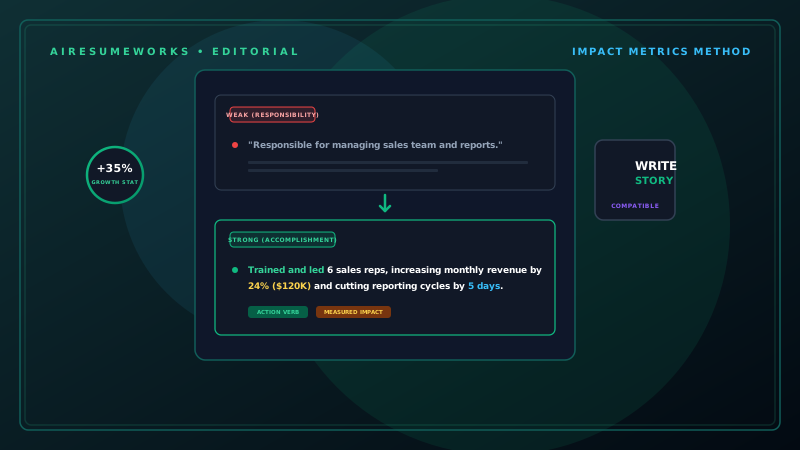
Resume bullet points are one of the most important parts of your work experience section. They give employers a quick way to understand what you did, what skills you used, and what you accomplished in previous positions.
Weak bullet points often describe basic responsibilities without showing the value of the work. Stronger bullet points provide specific information and, when possible, demonstrate measurable results.
The goal is not to make every bullet point sound impressive. The goal is to make your actual experience clear, specific, relevant, and easy to understand.
What Is a Resume Bullet Point?
A resume bullet point is a short statement used to describe a responsibility, accomplishment, or contribution. For example:
• Assisted customers with questions and concerns. That tells the employer what you did, but it provides limited information. A stronger version might be:
• Assisted 40–60 customers daily, resolving product and service issues while maintaining accurate customer records. The second example provides more context.
It tells the employer:
- What you did
- How much work you handled
- What type of problems you addressed
- What additional responsibility was involved
- Start With a Strong Action Verb
Many effective resume bullet points begin with an action verb. Examples include:
- Managed
- Coordinated
- Created
- Developed
- Improved
- Increased
- Reduced
- Organized
- Trained
- Analyzed
- Implemented
- Maintained
- Supported
- Prepared
- Resolved
- Led
- Designed
- Processed
Compare:
Responsible for managing customer accounts. with:
Managed customer accounts and resolved service issues. The second version is more direct. Avoid beginning every bullet with the same verb. If every bullet starts with "Responsible for," the work experience section can quickly become repetitive.
Focus on What You Actually Did
A good bullet point should answer a simple question:
What did you do in this position?
For example:
Processed customer orders and maintained accurate transaction records. This is better than:
Worked in a busy office environment. The second statement provides little information about your actual contribution. Whenever possible, describe the specific activity.
Show the Result When You Can
Responsibilities explain what you did. Accomplishments explain what happened because of your work. For example:
Responsibility:
Managed inventory records. Accomplishment:
Maintained accurate inventory records and helped reduce stock discrepancies. The second example communicates a result. If you have measurable results, include them when they are accurate.
For example:
Reduced order-processing time by 20% by reorganizing the daily workflow. Specific results can make a bullet point much stronger.
Use Numbers When They Are Available
Numbers provide context. Consider including:
- Percentages
- Dollar amounts
- Number of customers
- Number of employees
- Number of projects
- Sales volume
- Time saved
- Production volume
- Team size
For example:
Trained 12 new employees on customer service procedures and company systems. This gives the employer more information than:
Trained new employees. Another example:
Managed scheduling for a team of 18 employees. is more specific than:
Managed employee schedules. Do not invent numbers. If you do not know the exact figure, use a truthful general description rather than making one up.
Replace Weak Phrases
Certain phrases appear frequently on resumes but do not communicate much information. For example:
Weak:
Helped with customer service. Stronger:
Assisted customers with product questions, account issues, and service requests. Weak:
Responsible for paperwork. Stronger:
Prepared and maintained customer records, invoices, and daily administrative documents. Weak:
Worked with employees. Stronger:
Coordinated daily assignments and communicated workflow updates with team members. The stronger versions explain the work instead of simply stating that the person was involved.
Use the STAR Method
One useful way to strengthen resume bullets is to think about the STAR structure:
Situation — What was happening? Task — What needed to be done? Action — What did you do? Result — What happened? You do not need to include all four elements in every bullet.
The most useful parts for many resume bullets are the action and result. For example:
Reorganized customer records to improve information retrieval and reduce time spent searching for account information. This describes the action and its purpose.
If you have a measurable result:
Reorganized customer records, reducing average information-retrieval time by 25%. That is even more specific.
Describe Accomplishments Instead of Duties
Employers generally already know what a job involves. For example, they know that a cashier processes transactions. Instead of filling the resume with:
- Processed customer transactions.
- Answered customer questions.
- Stocked merchandise.
you can provide more context:
- Processed an average of 100 customer transactions per shift while maintaining accurate cash handling.
- Assisted customers with product questions and resolved routine concerns.
- Restocked high-demand merchandise and maintained organized sales displays.
The goal is to show how you performed the work.
Tailor Bullet Points to the Job
You do not necessarily need to use exactly the same bullet points for every application. If you are applying for a particular position, identify the responsibilities and skills emphasized in the job description.
Then highlight relevant experience. For example, if a job emphasizes customer relationship management, a relevant bullet might be:
• Managed customer accounts, responded to service requests, and maintained accurate customer information in a CRM system. If another job emphasizes scheduling, you might give greater attention to:
• Coordinated employee schedules and adjusted assignments to maintain daily staffing coverage. Both statements may come from the same job, but each emphasizes a different qualification.
Include Relevant Keywords
Bullet points are also an opportunity to use relevant resume keywords. If you genuinely have experience with a particular technology, process, or skill, identify it clearly.
For example:
• Used Microsoft Excel to prepare weekly sales reports and track account activity. If the job description specifically mentions Microsoft Excel, the employer can immediately see the connection.
Do not insert keywords that do not accurately describe your experience.
Avoid Keyword Stuffing
A bullet point should sound like normal professional writing. Avoid something like:
• Customer service representative provided customer service, customer support, customer communication, customer relations, and customer satisfaction. This contains keywords but provides little useful information.
A better version would be:
• Provided customer service to high-volume accounts, resolving billing and service issues while maintaining accurate customer records. The relevant terminology is included naturally.
Keep Bullet Points Concise
Resume bullet points should provide useful information without becoming paragraphs. A long bullet can be difficult to scan. Instead of:
• Responsible for handling many different customer service responsibilities including answering questions, resolving problems, updating account information, responding to complaints, and helping customers understand company policies and procedures.
Consider:
• Resolved customer questions and complaints while maintaining accurate account information and explaining company policies. The second version is easier to read.
Use Different Action Verbs
Repeating the same action verb can make your resume sound monotonous. For example, instead of:
- Managed customer accounts.
- Managed employee schedules.
- Managed inventory.
- Managed reports.
you could write:
- Managed customer accounts and resolved service issues.
- Coordinated employee schedules and daily assignments.
- Maintained inventory records and monitored stock levels.
- Prepared weekly performance reports for management.
The work itself has not changed. The writing is simply more precise.
Use the Correct Verb Tense
Use past tense for previous positions. For example:
- Managed customer accounts.
- Prepared weekly reports.
- Trained new employees.
For your current position, present tense can be appropriate:
- Manage customer accounts.
- Prepare weekly reports.
- Train new employees.
Consistency matters.
Avoid First-Person Language
Resume bullet points generally do not need phrases such as:
- I managed
- I created
- I was responsible for
- My duties included
Instead, use direct action statements. For example:
• Managed customer accounts and resolved service issues. This keeps the writing concise.
Demonstrate Soft Skills Through Actions
Soft skills such as communication, leadership, and teamwork can be difficult to demonstrate through a simple list. Instead of:
- Leadership
- Communication
- Teamwork
show those abilities through your experience. For example:
• Trained five new employees and provided ongoing support during their first 90 days. This demonstrates leadership and communication without simply claiming that you possess those qualities.
Show Problem Solving
Problem-solving experience can be valuable for many positions. Instead of:
• Good at solving customer problems. write:
• Resolved customer billing and service issues by reviewing account information and coordinating solutions with internal departments. This gives the employer evidence of problem-solving ability.
Show Leadership Without Exaggerating
You do not need to be a manager to demonstrate leadership. Examples include:
- Training employees
- Coordinating projects
- Leading meetings
- Mentoring coworkers
- Organizing events
- Assigning tasks
- Taking responsibility for a project
For example:
• Coordinated a four-person project team and tracked assignments to ensure deadlines were met. Only use language that accurately reflects your role.
Connect Skills to Results
Whenever possible, combine a skill with an outcome. Instead of:
• Used Excel. Try:
• Used Microsoft Excel to organize sales data and prepare weekly performance reports. Instead of:
• Customer service. Try:
• Resolved customer service issues while maintaining accurate account records and meeting daily service requirements. This makes the skill more meaningful.
Avoid Generic Resume Language
Certain phrases are so common that they provide little information. Examples include:
- Hardworking individual
- Team player
- Results-oriented professional
- Go-getter
- Highly motivated
- People person
- Responsible for
- Worked on
- Helped with
These phrases are not automatically wrong, but they are usually weaker than specific descriptions of what you actually accomplished. Show the quality through your experience instead.
Use Bullet Points for Each Position
A typical position might contain three to six bullet points, depending on how relevant and substantial the role is. For example:
Customer Service Representative
ABC Company — Atlanta, GA
2022–2026
Assisted 40–60 customers daily with account and service questions. Resolved billing and service issues while maintaining accurate customer records. Used Salesforce CRM to document customer interactions and account updates. Trained five new employees on customer service procedures. Consistently met daily customer service and response-time requirements.
This gives the employer a quick overview without requiring a long paragraph.
Prioritize Your Strongest Information
The first bullet point under a position often receives significant attention. Consider placing your strongest and most relevant accomplishment first. For example, if you helped reduce processing time by 25%, that may be more valuable than a routine responsibility.
Instead of organizing bullets strictly by the order in which you performed tasks, consider organizing them according to importance and relevance.
Use AI to Improve Weak Bullet Points
AI tools can help turn rough notes into more professional resume language. For example, you might start with:
Answered phones and helped customers. An AI tool could help you create:
Handled high-volume customer inquiries by phone, providing information and resolving routine service issues. You should then review the result. Ask:
Is it accurate? Does it describe what I actually did? Did the AI add anything I never did? Does the wording sound natural? Is it relevant to the job? AI can help with wording, but you remain responsible for the accuracy of the final statement.
Don't Let AI Add Fake Numbers
AI may sometimes assume that quantified results would make a bullet stronger. That does not mean you should accept those numbers. For example:
Increased customer satisfaction by 30%. If you never measured customer satisfaction, do not use that statement. You can still write:
Improved customer service processes by responding to customer concerns promptly and maintaining accurate account information. Accurate information is more valuable than an impressive but unsupported statistic.
Review Every Bullet for Relevance
Before submitting your resume, ask whether each bullet helps demonstrate your suitability for the job. Remove or shorten bullets that:
- Describe routine tasks without useful context
- Are unrelated to the position
- Repeat information from another bullet
- Contain vague language
- Add unnecessary details
Use the available space for information that strengthens your application.
A Simple Formula for Strong Resume Bullets
A useful formula is:
Action Verb + What You Did + How You Did It + Result
For example:
Reduced order-processing delays by reorganizing daily workflow procedures and improving task assignments. Another formula is:
Action Verb + Responsibility + Relevant Skill
For example:
Managed customer accounts using Salesforce CRM and maintained accurate account records. You do not need to force every bullet into a formula. Use these structures as starting points when you are unsure how to improve a weak statement.
- Examples of Stronger Bullet Points
- Customer Service
Weak:
Helped customers. Stronger:
Assisted customers with product and service questions and resolved routine account issues.
Administrative
Weak:
Did office work. Stronger:
Prepared documents, maintained records, scheduled appointments, and supported daily administrative operations.
Sales
Weak:
Sold products. Stronger:
Assisted customers with product selection and consistently supported daily sales goals.
Management
Weak:
Managed employees. Stronger:
Supervised a team of 12 employees, coordinated daily assignments, and provided ongoing performance support.
Technology
Weak:
Worked on websites. Stronger:
Developed responsive websites using HTML, CSS, and JavaScript for desktop and mobile users. These examples demonstrate the difference between simply naming a responsibility and explaining the work more effectively.
Your Resume Bullets Should Tell a Story
Your work experience section should allow an employer to understand your professional progression. Your bullet points should show:
- What you were responsible for
- What skills you used
- What problems you solved
- What you accomplished
- How your experience relates to the position
You do not need to tell a literal story. Instead, the collection of bullet points should create a clear picture of your professional abilities.
Proofread Your Bullet Points
Before submitting your resume, check each bullet for:
- Spelling
- Grammar
- Punctuation
- Verb tense
- Accuracy
- Repetition
- Unnecessary words
- Incorrect numbers
- Incorrect company or software names
Also make sure your bullet points use consistent formatting. Strong resume bullet points do not need to be complicated. They need to communicate specific information about your work and the value you provided.
Start with a strong action verb, describe what you actually did, include relevant skills and keywords naturally, and add measurable results whenever you have accurate information available. Avoid vague phrases, unnecessary repetition, and unsupported claims.
Your resume should not simply tell an employer what your job title was. Your bullet points should show how you performed the job, what you contributed, and why that experience is relevant to the position you want.