Resume Format Examples: How to Choose the Right Format
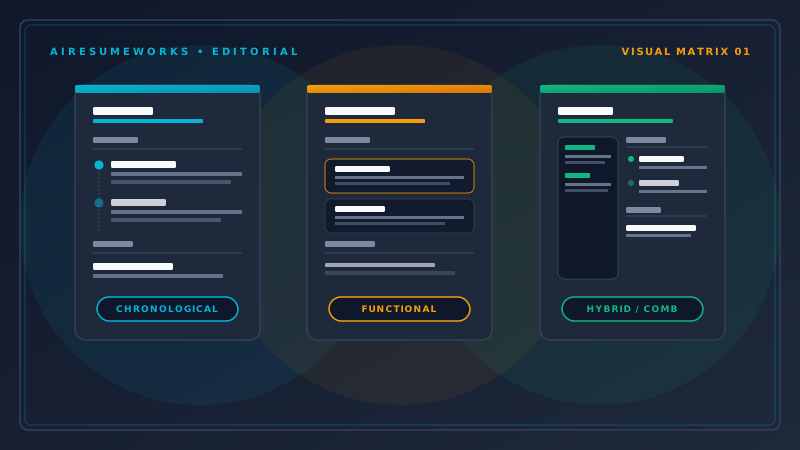
Resume Format Examples: How to Choose the Right Format Choosing the right resume format can make a big difference in how quickly a hiring manager understands your experience. A well-organized resume puts your strongest qualifications where employers can find them easily, while the wrong format can make even good experience difficult to follow.
The three most common resume formats are chronological, functional, and combination. For most job seekers, the chronological format is the best starting point, but your work history and career situation should determine which format makes the most sense.
In this guide, we'll look at resume format examples, explain when to use each one, and show you how to choose the right format for your situation.
- The 3 Main Resume Formats
- Reverse-Chronological Resume Format
The reverse-chronological format is the most familiar resume structure. Your most recent position appears first, followed by earlier jobs in reverse order.
Typical structure:
Name and contact information
Professional summary
Work experience
Education
Skills
Additional relevant sections
Example
JAMES CARTER Atlanta, GA | james.carter@email.com | 555-123-4567 PROFESSIONAL SUMMARY Customer service professional with 7+ years of experience supporting customers, resolving complex issues, and improving client satisfaction.
PROFESSIONAL EXPERIENCE
Customer Service Supervisor
ABC Services — Atlanta, GA
2022–Present
Supervise a team of 12 customer service representatives. Resolve escalated customer issues and complaints. Improved team response time by 18% through workflow changes.
Customer Service Representative
XYZ Company — Atlanta, GA
2018–2022
Assisted customers by phone, email, and chat. Maintained accurate customer records. Consistently exceeded monthly performance targets.
EDUCATION
- Bachelor of Business Administration
- Georgia State University
SKILLS
Customer Service | Team Leadership | CRM Software | Conflict Resolution
When should you use it?
The reverse-chronological format is usually a strong choice when:
You have relevant work experience. Your employment history is relatively consistent. Your recent positions demonstrate career progression. You are applying for jobs similar to your previous roles.
For many experienced professionals, this is the safest and easiest format for employers to understand.
2. Functional Resume Format
A functional resume emphasizes skills and qualifications rather than putting your employment history at the center. Instead of leading with a detailed timeline of jobs, the resume groups experience according to relevant skills.
Example
JAMES CARTER Atlanta, GA | james.carter@email.com | 555-123-4567 PROFESSIONAL SUMMARY Customer-focused professional with experience in client communication, problem resolution, team coordination, and administrative support.
CORE SKILLS
Customer Relations
Handled customer questions and complaints. Built positive relationships with clients. Communicated effectively with customers across multiple channels.
Team Leadership
Trained new employees. Coordinated daily team activities. Assisted supervisors with employee scheduling.
Administrative Support
Maintained customer records. Prepared reports and documentation. Managed multiple priorities in a fast-paced environment.
PROFESSIONAL EXPERIENCE
- Customer Service Representative — XYZ Company
- 2018–2022
- Administrative Assistant — ABC Office Solutions
- 2015–2018
EDUCATION
- Bachelor of Business Administration
- Georgia State University
When can it be useful?
A functional format may be considered when:
You are changing careers. You have significant employment gaps. You have limited traditional work experience. Your transferable skills are more important than your job titles. You have experience from several unrelated fields.
However, there is an important consideration: some employers may prefer to see your employment history clearly presented. A functional resume can sometimes make it less obvious where and when you gained your experience. For that reason, it isn't necessarily the best choice simply because you have an employment gap or are changing careers.
3. Combination Resume Format
A combination resume combines elements of the chronological and functional formats. It highlights your most important skills and accomplishments while still providing a detailed employment history.
Example
JAMES CARTER Atlanta, GA | james.carter@email.com | 555-123-4567
PROFESSIONAL SUMMARY
Customer service supervisor with 7+ years of experience in customer relations, team leadership, training, and operational improvement.
CORE COMPETENCIES
- Customer Relationship Management
- Team Leadership
- Employee Training
- Conflict Resolution
- Process Improvement
SELECTED ACHIEVEMENTS
Improved team response time by 18%. Trained more than 20 new representatives. Helped reduce escalated customer complaints through improved procedures.
PROFESSIONAL EXPERIENCE
Customer Service Supervisor
ABC Services — Atlanta, GA
2022–Present
Customer Service Representative
XYZ Company — Atlanta, GA
2018–2022
EDUCATION
- Bachelor of Business Administration
- Georgia State University
Who should consider it?
A combination resume can work particularly well for experienced professionals who want to emphasize specific skills while still showing a clear career history.
It can also be useful for career changers who have substantial transferable skills that aren't obvious from their previous job titles.
Which Resume Format Is Best?
For most job seekers, reverse-chronological is the best place to start. It gives employers a straightforward view of:
- What you do now
- Where you've worked
- How your career has progressed
- What responsibilities you've handled
A functional or combination format may make more sense when your career history doesn't tell the full story. Here's a simple comparison:
Resume Format Best For Main Advantage Reverse-Chronological Most experienced job seekers Clear employment history Functional Certain career changers or people emphasizing skills Highlights transferable skills Combination Experienced professionals with strong skills Balances skills and work history
The important thing is not to choose a format simply because it is popular. Choose the format that makes your most relevant qualifications easiest to understand.
Resume Format for a Career Changer
Changing careers can make resume formatting more challenging. For example, suppose you've spent eight years working in retail management but want to move into project coordination.
A resume focused entirely on retail job titles may not immediately communicate why you're qualified for project-related work. A combination format could help you highlight transferable skills such as:
- Team coordination
- Scheduling
- Budget management
- Vendor communication
- Problem solving
- Process improvement
You can then connect those skills to accomplishments from your previous positions. The goal isn't to hide your previous career. It's to translate your existing experience into qualifications that make sense for the new position.
Resume Format for Someone With No Experience
If you're writing your first resume, you don't necessarily need a functional resume. A simple chronological structure can still work. You can include relevant experience such as:
- Internships
- Part-time employment
- Volunteer work
- School projects
- Freelance work
- Student organizations
- Relevant coursework
For example, a student applying for an entry-level marketing position might emphasize a school marketing project, volunteer social media work, and relevant coursework even without previous full-time marketing employment.
The key is to focus on relevant experience rather than simply full-time employment.
Resume Format for Employment Gaps
An employment gap doesn't automatically mean you need a functional resume. In many cases, a straightforward chronological resume is still easier to understand.
If the gap needs explanation, you can briefly address legitimate activities during that period, such as:
Education
Caregiving
Freelance work
Contract work
Volunteering
Professional development
Job searching
Don't create complicated formatting just to make a gap less noticeable. A clear resume is generally better than one that makes the reader work to understand your history.
How Long Should a Resume Be?
Resume length depends on your experience and the requirements of the position. A recent graduate may only need one page, while an experienced professional may require more space to present relevant accomplishments.
The goal isn't to reach a specific page count. Instead, ask:
Does every section help demonstrate why I'm qualified for this job?
If something isn't relevant, consider removing it. If an important accomplishment needs additional space, don't remove useful information simply to force the resume onto one page.
Should Your Resume Use a Traditional Design?
Your resume doesn't need to be boring, but readability should come before decoration. A professional resume should generally have:
- Clear section headings
- Consistent formatting
- Easy-to-read fonts
- Appropriate spacing
- Simple bullet points
- Consistent dates and job titles
- A logical information hierarchy
Avoid excessive graphics, decorative elements, or complicated layouts that make important information harder to find. This is especially important when submitting resumes through online application systems.
How to Choose the Right Resume Format
Before choosing a format, ask yourself these five questions:
1. Is my recent experience relevant?
If your recent work directly relates to the position you're seeking, reverse-chronological is often a strong choice.
2. Do I have a consistent career history?
If your employment history shows steady progression, chronological formatting can showcase that progression effectively.
3. Am I changing careers?
If you're changing fields, consider whether a combination format would help highlight your transferable skills.
4. Do I have limited experience?
If you're a student, recent graduate, or entry-level applicant, focus on education, projects, internships, volunteer experience, and relevant skills.
5. Can someone understand my qualifications quickly?
This may be the most important question of all. Look at your resume from the perspective of someone seeing it for the first time. Can they quickly determine:
Who you are → what you can do → what you've accomplished → why you're qualified?
If not, the problem may be the organization rather than the amount of information. The best resume format isn't necessarily the most creative or the one with the most sections. It's the format that makes your most relevant qualifications easy to find and understand.
For most job seekers, the reverse-chronological format is a strong starting point because it presents your career history clearly. A functional format can emphasize skills in situations where your traditional employment history doesn't represent your qualifications well, while a combination format can balance skills and career experience.
Whatever format you choose, tailor the resume to the position you're applying for. A well-structured resume that clearly connects your experience to the job is more useful than an elaborate design that makes the reader search for your qualifications.
The best format is the one that makes your strongest qualifications impossible to miss.