Resume Keywords: How to Find and Use the Right Keywords
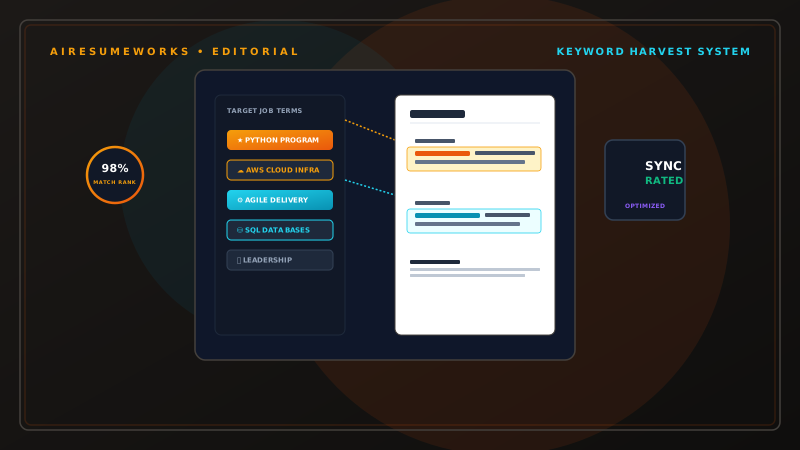
Resume keywords are words and phrases that describe the skills, qualifications, experience, and other requirements employers are looking for in a candidate.
Using relevant keywords on your resume can make it easier for employers and applicant tracking systems (ATS) to identify your qualifications. The key is to use keywords naturally and accurately. Adding every keyword you see in a job description will not create a better resume. The goal is to make sure your resume clearly communicates the qualifications you actually have.
What Are Resume Keywords?
Resume keywords are terms that are relevant to a particular job, industry, or profession. They can include:
- Job titles
- Technical skills
- Software
- Certifications
- Industry terminology
- Professional skills
- Education requirements
- Job-specific responsibilities
- Tools and technologies
For example, a customer service job might mention:
- Customer service
- CRM
- Account management
- Conflict resolution
- Communication
- Microsoft Office
A technology position might mention:
- JavaScript
- Python
- SQL
- Git
- Cloud computing
- Software development
The appropriate keywords depend on the position.
Why Are Keywords Important?
Employers often receive large numbers of applications. Applicant tracking systems can help employers organize those applications and search for information related to job requirements.
A recruiter may also quickly scan a resume looking for particular qualifications. If you have the required experience but describe it using completely different terminology, the connection may not be immediately obvious.
For example, an employer may specifically request:
Project management experience. If your resume says:
Helped organize various business activities. that description is vague. If you actually performed project management responsibilities, a clearer statement might be:
Coordinated project schedules, tracked deadlines, and communicated project updates with team members. The second version makes the relevant experience much easier to identify.
Start With the Job Description
The job description is one of the best places to find keywords for a particular application. Read it carefully and look for repeated or emphasized terms.
Pay particular attention to:
Required qualifications
Preferred qualifications
Technical skills
Software
Certifications
Job responsibilities
Education
Industry-specific terminology
For example, suppose a job posting repeatedly mentions:
- Customer relationship management
- Salesforce
- Account management
- Customer retention
Those terms may be important when tailoring your resume.
Separate Required and Preferred Keywords
Job descriptions often contain both required and preferred qualifications. Required qualifications should generally receive greater attention because they represent the employer's core expectations.
For example:
Required:
- Customer service experience
- Microsoft Excel
- Communication skills
Preferred:
- Salesforce experience
- Bilingual ability
- Team leadership
If you possess the required qualifications, make sure they are clearly represented on your resume. Then consider adding relevant preferred qualifications that you genuinely possess.
Look for Different Types of Keywords
Not all keywords are skills.
Job Titles
Job titles can be important because employers may search for candidates with particular professional backgrounds. Examples include:
- Marketing Manager
- Registered Nurse
- Administrative Assistant
- Software Developer
- Sales Representative
Use accurate job titles on your resume. Do not change a job title simply to insert a keyword that does not accurately describe your position.
Technical Skills
Technical skills are often highly searchable. Examples include:
- Microsoft Excel
- SQL
- Python
- JavaScript
- Salesforce
- Adobe Photoshop
If you have experience with a specific tool or technology, identify it accurately.
Certifications
Certifications can also function as keywords. Examples include:
- PMP
- CPA
- CompTIA A+
- CNA
- AWS certifications
If a certification is required and you possess it, make sure it is clearly visible on your resume.
Industry Terms
Some industries use specialized terminology. Healthcare, technology, finance, engineering, construction, marketing, and many other fields have terminology that employers expect qualified candidates to understand.
Using appropriate industry language can make your experience easier to understand.
Soft Skills
Soft skills can also appear in job descriptions. Examples include:
- Leadership
- Communication
- Teamwork
- Problem solving
- Organization
- Time management
However, simply listing soft skills is often less persuasive than demonstrating them through your work experience. Instead of only writing:
Leadership
you might write:
Trained and supported five new employees during their first 90 days. That provides evidence of leadership and training ability.
Use Keywords Naturally
Keywords should fit naturally into your resume. For example:
Managed customer accounts using Salesforce CRM and resolved service issues while maintaining accurate account records. This sentence includes relevant terms without sounding like a collection of keywords.
Avoid writing something like:
Customer service, Salesforce, CRM, account management, customer service skills, customer retention, customer communication. A recruiter may find that difficult to read, and it does not demonstrate how you actually used those skills.
Use Exact Terms When Appropriate
Sometimes it is useful to use the same terminology found in the job description. For example, if the employer specifically asks for:
Microsoft Excel
and you have that experience, use "Microsoft Excel" rather than only saying:
Spreadsheet software
Likewise, if an employer asks for:
Project Management
and that accurately describes your experience, including the phrase "project management" can make the connection clearer. This does not mean copying the job description.
It means using accurate terminology that describes your actual qualifications.
Include Keywords in the Right Sections
Relevant keywords can appear throughout your resume.
Professional Summary
Use important qualifications in your summary when they genuinely represent your background.
Work Experience
This is often one of the strongest places to demonstrate keywords because you can connect them to actual responsibilities and accomplishments.
Skills
Use a skills section to make important abilities easy to find.
Certifications
Clearly identify relevant credentials.
Projects
Projects can demonstrate technical skills and other qualifications that may not appear in your employment history. Using keywords throughout the resume can create a more complete picture of your qualifications.
Don't Repeat the Same Keyword Excessively
There is no need to repeat the same keyword in every section. For example, if "customer service" appears naturally in your summary, skills section, and relevant work experience, that may be sufficient.
Repeating it ten or twenty times does not make your resume stronger. Write for the person reading the resume rather than trying to maximize a keyword count.
Don't Add Keywords You Don't Have
This is one of the most important rules of resume keyword optimization. If a job description lists:
- Python
- SQL
- Tableau
and you only know SQL, do not add Python and Tableau simply because they could improve your keyword match. Your resume should accurately represent your qualifications.
The same applies to:
Certifications
Job titles
Years of experience
Software
Management experience
Education
Languages
Keyword optimization should never become misrepresentation.
Use Related Terms Carefully
Sometimes a job description uses one term while your experience uses a closely related term. For example, a posting may ask for:
Client relationship management
while your resume says:
Customer account management
Depending on your actual responsibilities, these may overlap, but they are not necessarily identical. You can clarify the connection when it is accurate.
For example:
Managed customer accounts and maintained long-term client relationships. This gives both concepts appropriate context without falsely claiming experience you do not have.
Keywords for Career Changers
Career changers often need to pay special attention to keywords because their previous job titles may not match the new industry. Suppose someone worked as a retail manager and wants to move into office administration.
Their previous experience might include:
- Employee scheduling
- Record keeping
- Customer communication
- Inventory management
- Staff training
- Daily operations
An administrative job description might emphasize:
- Scheduling
- Administrative support
- Data entry
- Customer communication
- Office operations
The candidate should emphasize the genuine overlap between their previous experience and the new position. The goal is not to make the previous job appear to be something it was not.
The goal is to make transferable qualifications easier to recognize.
Keywords for People With No Experience
People applying for their first job may have fewer professional keywords available. That does not mean they have nothing to include. Relevant keywords may come from:
Education
Internships
Volunteer work
Projects
Training
Certifications
Part-time jobs
School activities
For example, a student applying for an entry-level marketing position might have experience with:
- Social media
- Content creation
- Research
- Microsoft Office
- Presentation development
Those abilities can be included when they genuinely apply.
Use Keywords in Accomplishment Statements
One of the strongest ways to use keywords is to combine them with results or responsibilities. Instead of:
Excel
try:
Used Microsoft Excel to maintain weekly sales reports and track customer account activity. Instead of:
Customer service
try:
Provided customer service to high-volume accounts and resolved billing and service issues. This approach gives the keyword context. It also gives the employer evidence that you actually used the skill.
Use an ATS or Resume Keyword Scanner
Some online resume tools can compare your resume with a job description and identify potential keyword gaps. These tools may show:
- Keywords you already have
- Keywords found in the job description
- Missing terms
- Matching skills
- Potential areas for improvement
Such tools can be useful when tailoring a resume. However, do not automatically add every suggested keyword. Review each recommendation and determine whether it accurately applies to your experience.
AI Can Help Identify Keywords
AI can also be used to analyze a job description. You can provide the job posting and ask an AI tool to identify:
- Important skills
- Required qualifications
- Repeated terminology
- Software
- Certifications
- Job responsibilities
You can then compare those terms with your own resume. AI can help you identify connections that you might overlook, but it should not decide which qualifications you actually possess.
That determination has to come from your real experience.
Create a Personal Keyword Bank
If you apply for jobs regularly, creating a personal keyword bank can save time. Your keyword bank might contain:
Technical Skills
- Microsoft Excel
- Salesforce
- SQL
Professional Skills
- Customer service
- Project coordination
- Account management
Industry Terms
- Customer retention
- Inventory management
- Quality assurance
Certifications
Relevant certifications
You can then select the appropriate terms when tailoring your resume. Do not put the entire keyword bank on every resume. Choose only the terms relevant to the position.
Check Keyword Placement
After tailoring your resume, review where your important keywords appear. Ask:
Are the most important qualifications easy to find? Are required skills mentioned? Are relevant skills connected to actual experience? Are job-specific terms used accurately? Are keywords concentrated in one section? Does the resume still sound natural?
A keyword buried in an unrelated section may not communicate your qualifications as effectively as a relevant work experience bullet.
Keyword Matching Is Not the Same as Job Matching
A resume can contain many keywords and still be a poor match for a job. For example, someone might add every technical term from a job description without having meaningful experience with those technologies.
The resulting resume might contain many matching words but provide little evidence of competence. Employers ultimately want qualified candidates, not keyword collections.
Your resume should demonstrate how your experience relates to the position.
Proofread After Adding Keywords
Tailoring a resume can sometimes introduce awkward wording. After adding or changing keywords, read the entire resume again. Look for:
- Repetition
- Grammar problems
- Unnatural phrases
- Inconsistent terminology
- Incorrect capitalization
- Spelling errors
- Duplicate information
A resume should sound like a professional document, not a collection of search terms.
A Simple Resume Keyword Process
You can use the following process for almost any job application. Step 1: Read the job description. Identify the major requirements. Step 2: Highlight important terms.
Look for skills, software, certifications, responsibilities, and industry terminology. Step 3: Compare the requirements with your background. Identify the qualifications you genuinely possess.
Step 4: Add relevant keywords to your resume. Use them naturally in your summary, experience, skills, projects, or certifications. Step 5: Remove irrelevant information.
Make room for qualifications that matter to the specific position. Step 6: Review the final resume. Make sure it remains readable and accurate. Step 7: Check for keyword gaps.
An ATS or resume keyword tool can provide another perspective. Step 8: Proofread. Make sure the final version contains no errors. The Goal Is Relevance, Not Keyword Quantity
Resume keywords can help employers recognize relevant qualifications, but keywords alone do not make a strong resume. The strongest approach is to combine:
- Accurate qualifications
- Relevant terminology
- Specific accomplishments
- Clear writing
- Professional formatting
- Job-specific tailoring
Think of keywords as a way to connect your experience with the language of the job description. When a qualification genuinely matches what an employer is seeking, make that connection easy to see. Use the employer's terminology when appropriate, provide evidence through your experience, and avoid adding anything that is not true.
A well-tailored resume does not try to fool an ATS. It simply makes your real qualifications clearer, more relevant, and easier for both software and people to recognize.