Resume Sample for a Job Application: Complete Example and Tips
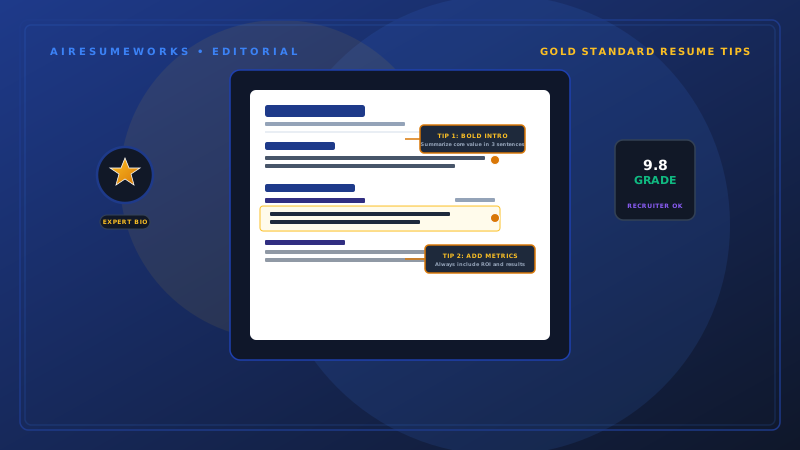
A resume sample for a job application can help you understand how to organize your experience, skills, education, and other qualifications before applying for a position.
A sample is especially useful when you're unsure what information belongs on a resume or how much detail to include. However, a sample should be used as a guide rather than something to copy word-for-word.
Your resume should reflect your own experience and be tailored to the specific job you're applying for.
What Should a Resume for a Job Application Include?
A typical resume may include:
Name and contact information
Professional summary
Work experience
Skills
Education
Certifications
Projects
Volunteer experience
Other relevant qualifications
You don't necessarily need every section. The right sections depend on your experience and the requirements of the position. The most important goal is to make your relevant qualifications easy to find.
Complete Resume Sample
Here is an example of a professional resume for a customer service position. JORDAN WILLIAMS Atlanta, GA | 555-555-5555 | jordan.williams@email.com linkedin.com/in/jordanwilliams
Professional Summary
Customer service professional with 6 years of experience assisting customers, resolving account issues, managing customer records, and supporting daily service operations. Experienced in communication, problem solving, account management, and customer relationship management.
Professional Experience
Customer Service Representative
ABC Services — Atlanta, GA
2021–Present
Respond to customer questions by phone, email, and online support channels. Resolve account and service issues while following company procedures. Maintain accurate customer records and document customer interactions. Handle escalated customer concerns and coordinate solutions with internal departments. Assist customers with product information, account questions, and service requests.
- Customer Support Associate
- XYZ Company — Atlanta, GA
- 2018–2021
Responded to customer inquiries and provided information about products and services. Processed account updates and service requests. Maintained accurate customer records and documentation. Helped resolve customer complaints and service problems. Worked with team members to improve customer support procedures. Skills Customer Service Account Management Problem Solving Communication Microsoft Office Customer Relationship Management Data Entry Team Collaboration Education
- Bachelor of Business Administration
- Example University — Atlanta, GA
This sample provides a basic structure that can be adapted to many professional positions. The actual information should always be replaced with your own experience.
Start With Your Contact Information
Your name and contact information should be easy to find near the top of your resume. Common information includes:
- Full name
- Phone number
- Professional email address
- City and state
- LinkedIn profile
- Professional website or portfolio
You generally don't need to include unnecessary personal information. Use a professional email address that you check regularly.
Write a Strong Professional Summary
A professional summary gives the employer a quick introduction to your background. It should focus on information that is relevant to the position. For example:
Operations manager with 10 years of experience leading teams, improving workflows, and supporting daily business operations. Experienced in workforce planning, process improvement, performance management, and employee training.
This is more useful than a generic statement such as:
Hard-working professional seeking a challenging opportunity. The second statement doesn't provide enough information about the candidate's actual qualifications.
Customize the Summary for the Job
Your professional summary should change when the target position changes. Suppose you have experience in both customer service and administration. For a customer service position, you might emphasize:
- Customer relationships
- Problem solving
- Account management
- Communication
For an administrative position, you might emphasize:
- Scheduling
- Organization
- Records management
- Office software
Your underlying experience remains the same, but the information that receives the most attention can change.
List Your Work Experience Clearly
For most job applications, work experience should be listed in reverse chronological order. Your most recent position normally appears first. Each entry should clearly show:
- Job Title
- Company — Location
- Employment Dates
Then use bullet points to describe your responsibilities and accomplishments. For example:
- Administrative Assistant
- ABC Corporation — Atlanta, GA
- 2022–Present
Coordinate calendars and appointments for department staff. Prepare reports, documents, and correspondence. Maintain electronic and paper records. Respond to customer and vendor inquiries. Process invoices and other administrative documents.
This format makes your career history easy to scan.
Focus on Relevant Experience
You don't have to give every previous job the same amount of space. Recent and relevant positions should generally receive more attention. For example, if you're applying for an accounting position, previous accounting and finance experience may deserve detailed descriptions.
An unrelated job from many years ago may require much less information. The purpose of the resume is to demonstrate why you're qualified for the position.
Use Strong Action Verbs
Start your bullet points with clear action verbs when appropriate. Examples include:
- Managed
- Coordinated
- Developed
- Created
- Improved
- Organized
- Analyzed
- Implemented
- Trained
- Maintained
- Monitored
- Resolved
- Prepared
- Designed
For example:
Instead of:
Responsible for managing customer accounts. Use:
Managed customer accounts and resolved service issues. Instead of:
Responsible for employee training. Use:
Trained new employees on company procedures and customer service standards. Direct language makes your responsibilities easier to understand.
Include Accomplishments When Possible
Responsibilities tell an employer what you were expected to do. Accomplishments can show what you actually achieved. For example:
Managed inventory. is fairly general. A stronger statement might be:
Managed inventory for a high-volume retail location and improved stock organization to reduce product shortages. If you have legitimate measurable results, include them.
For example:
Trained 15 new employees on customer service procedures and company systems. Don't invent numbers or results. If you don't have measurable accomplishments, simply describe your responsibilities accurately.
Add Relevant Skills
Your skills section should contain abilities that are relevant to the job. For example, an administrative position might require:
- Microsoft Office
- Scheduling
- Data Entry
- Records Management
- Communication
- Organization
A technical position might require:
- Programming
- Network Administration
- Database Management
- Technical Support
- Cybersecurity
Only include skills you genuinely possess. Don't add skills simply because they appear in the job description.
Use the Job Description to Identify Important Qualifications
Before submitting your resume, read the job description carefully. Look for:
- Required skills
- Preferred skills
- Certifications
- Education requirements
- Software
- Job responsibilities
- Industry terminology
Then compare those requirements with your resume. If the employer is looking for project management experience and you genuinely have that experience, make sure your resume clearly communicates it.
Use Keywords Naturally
Keywords can be useful when applying through online systems. If a job description uses terms such as "project management," "customer relationship management," or "data analysis," and those terms accurately describe your experience, consider using the terminology naturally in your resume.
Don't repeat keywords unnecessarily. Your resume should still be easy and natural for a person to read.
Resume Sample for Someone With No Experience
A person applying for their first job can structure a resume differently. For example:
JORDAN WILLIAMS Atlanta, GA | 555-555-5555 | jordan.williams@email.com
Professional Summary
Recent graduate with strong communication, organization, and computer skills seeking an entry-level administrative position. Experienced in team-based academic projects and volunteer activities.
Education
- Bachelor of Arts in Communications
- Example University — Atlanta, GA
- 2026
Relevant Experience
- Volunteer Assistant
- Community Organization — Atlanta, GA
- 2025–2026
Assisted visitors with registration and general questions. Organized supplies and maintained an orderly work area. Worked with volunteers to complete daily activities. Academic Project
Community Outreach Project
Conducted research and organized project information. Worked with a team to develop a communication plan. Presented project findings to instructors and classmates. Skills Communication Organization Microsoft Office Teamwork Customer Service
Someone without extensive employment experience can still create a useful resume by emphasizing education, projects, volunteer work, internships, skills, and other relevant experience.
Resume Sample for a Career Changer
Career changers should emphasize transferable skills. For example, someone moving from retail management into office administration could highlight:
- Scheduling
- Employee training
- Record keeping
- Customer service
- Inventory management
- Daily operations
- Communication
A professional summary might say:
Retail management professional with 8 years of experience coordinating schedules, maintaining records, training employees, resolving customer issues, and supporting daily operations. Seeking to transition into an administrative position by applying strong organizational and communication skills.
This helps connect previous experience with the new career.
Resume Sample for an Experienced Professional
Experienced professionals may need to provide more detail about their career accomplishments. For example:
MICHAEL JOHNSON Atlanta, GA | 555-555-5555 | michael.johnson@email.com
Professional Summary
Operations manager with more than 10 years of experience leading teams, improving processes, managing daily operations, and supporting business objectives.
Professional Experience
- Operations Manager
- ABC Company — Atlanta, GA
- 2018–Present
Manage daily operations for a 35-person team. Coordinate staffing, workflow assignments, and operational priorities. Monitor performance metrics and identify opportunities for improvement. Train employees and provide ongoing performance support. Develop process improvements designed to increase operational efficiency.
- Assistant Operations Manager
- XYZ Company — Atlanta, GA
- 2014–2018
Supported daily operations and supervised a team of 15 employees. Assisted with employee training and scheduling. Prepared operational reports for management. Helped implement updated workflow procedures. Skills Operations Management Team Leadership Process Improvement Workforce Planning Performance Management Education
- Bachelor of Business Administration
- Example University
Experienced candidates should focus on the accomplishments and responsibilities that best demonstrate their qualifications for the position.
Should You Include Every Job?
Not necessarily. Your resume should focus on relevant experience. If you've had many jobs, listing every position in detail can make the resume unnecessarily long.
Consider the relevance of each position. A previous job may deserve more attention if it demonstrates skills directly related to the position you're applying for.
Older or unrelated positions can often be shortened or omitted when appropriate. Certain applications, such as federal positions, may have specific requirements, so follow the instructions provided by the employer.
What About Employment Gaps?
Employment gaps don't automatically mean your resume will be rejected. Don't provide inaccurate dates to hide a gap. Instead, focus on presenting your actual employment history clearly.
If you gained relevant experience during a gap through education, freelance work, volunteer activities, training, or other activities, you may be able to include that information when appropriate.
The best approach depends on your circumstances.
Keep the Design Professional
A resume should be easy to read. You don't need elaborate graphics or complicated layouts. Use:
- Readable fonts
- Clear headings
- Consistent spacing
- Appropriate margins
- Simple formatting
- Easy-to-scan bullet points
Be cautious with templates that rely heavily on graphics, icons, charts, or multiple columns. A clean resume can still look modern and professional.
Consider ATS-Friendly Formatting
Many employers use Applicant Tracking Systems to manage job applications. These systems may scan resumes for information such as:
Skills
Job titles
Education
Qualifications
Keywords
Work experience
A straightforward resume format can make your information easier to process. Standard headings such as Professional Experience, Education, and Skills can make the document easier to understand.
Avoid placing important information inside images or decorative elements.
Proofread Your Resume
Before submitting your application, carefully review the entire resume. Check:
Spelling
Grammar
Contact information
Employment dates
Job titles
Company names
Education
Skills
Formatting
Page breaks
Also make sure that the information in your resume matches the information you provide elsewhere in the application. An incorrect phone number or email address can prevent an employer from contacting you.
Save a Master Resume
If you apply for multiple positions, keep a complete master version of your resume. The master version can contain all of your relevant experience, skills, accomplishments, certifications, and other information.
You can then create customized versions for specific jobs. For example, you might create:
- Customer Service Resume
- Administrative Resume
- Operations Resume
- Sales Resume
This is often faster than rebuilding your resume from the beginning for every application.
Use AI to Improve Your Resume
AI resume tools can help with parts of the resume-writing process. You can use AI to:
- Improve bullet points
- Create a professional summary
- Identify relevant keywords
- Compare your resume with a job description
- Find unclear or repetitive language
- Suggest ways to organize information
However, always verify AI-generated content. AI should not invent qualifications, employment history, accomplishments, statistics, or skills. Give the tool accurate information and review the result before using it.
Don't Copy a Resume Sample
A resume sample is useful because it shows you how a professional resume can be organized. It should not become a document that you copy word-for-word.
The sample's:
Job titles
Companies
Accomplishments
Skills
Education
Dates
belong to the example candidate. Replace them with your own information. The goal is to use the sample to understand structure and presentation while creating a resume that accurately represents your background.
A Resume Sample Should Help You Build Your Own Resume
A good resume sample gives you a starting point when you're unsure how to organize your information. Use it to understand how to structure your contact information, professional summary, work experience, education, skills, and other relevant sections.
Then customize everything to reflect your actual career. Keep the design clean, use clear language, focus on relevant qualifications, and tailor the resume to the position you're applying for.
Your resume doesn't need to look exactly like a sample to be effective. What matters most is that it clearly communicates your real experience and qualifications and makes it easy for an employer to understand why you could be a good fit for the job.