Resume Sections: What to Include on a Modern Resume
A strong resume is more than a list of jobs and skills. The sections you include, the order you use, and the information you place in each section can make a major difference in how easily employers and applicant tracking systems (ATS) can understand your background.
There is no single set of resume sections that works perfectly for every job seeker. Someone with ten years of experience may need a different structure than a recent graduate, career changer, or person applying for their first job.
The goal is to include the sections that help an employer quickly understand who you are, what you can do, and why you are qualified for the job. Here are the most common resume sections and how to use them effectively.
1. Contact Information
Your contact information should appear near the top of your resume where employers can easily find it. Include:
- Full name
- Phone number
- Professional email address
- City and state
- LinkedIn profile, if relevant
- Professional website or portfolio, if relevant
You generally do not need to include your full street address. Make sure your email address looks professional. An address based on your name is usually better than an outdated nickname or personal phrase.
For example:
Michael Johnson Atlanta, GA (404) 555-0123 michael.johnson@email.com linkedin.com/in/michaeljohnson Check your phone number and email address carefully. A small typo could prevent an employer from contacting you.
2. Resume Summary or Professional Profile
A resume summary gives employers a quick overview of your professional background. It is particularly useful for people with several years of experience.
A good summary can mention:
- Your professional background
- Years of experience
- Key areas of expertise
- Important accomplishments
- The type of position you are seeking
For example:
Customer service professional with 7+ years of experience supporting customers, resolving complex issues, and improving service quality. Experienced in high-volume environments, account management, and team training.
The summary should be specific rather than filled with vague phrases such as "hardworking professional" or "results-driven individual." Focus on information that relates directly to the position.
3. Resume Objective
A resume objective is another type of introduction, but it is generally more focused on the job seeker's goals. Objectives can be useful for:
- Recent graduates
- Students
- People entering a new career
- People with limited professional experience
- Career changers
For example:
Recent business administration graduate seeking an entry-level administrative position where strong organizational, communication, and customer service skills can contribute to an efficient office environment.
An objective should not simply say what you want from the employer. It should also explain what you can bring to the position. For experienced professionals, a strong summary is often more useful than a traditional objective.
4. Work Experience
For many job seekers, the work experience section is the most important part of the resume. List your relevant employment history, generally starting with your most recent position.
Each position can include:
- Job Title
- Company Name — City, State
- Month Year – Month Year
Then use bullet points to describe your responsibilities and accomplishments. Instead of:
Responsible for customer service
Use something more specific:
Assisted 40–60 customers daily, resolving account and service issues while maintaining accurate records. Whenever possible, describe results, not just duties.
You can strengthen experience bullets by including:
- Numbers
- Percentages
- Revenue
- Time savings
- Customer volume
- Productivity improvements
- Team size
- Performance results
Do not invent numbers simply to make a resume sound more impressive. Use measurable information only when it is accurate.
5. Skills
The skills section gives employers a quick way to identify your relevant abilities. Depending on the position, skills might include:
- Customer service
- Project management
- Microsoft Excel
- Data analysis
- Sales
- Communication
- Scheduling
- JavaScript
- Python
- Graphic design
- Medical terminology
- Inventory management
Avoid creating a huge list of unrelated skills. Instead, compare your skills with the job description and emphasize abilities that are actually relevant to the position.
This is also important for ATS systems because employers may search resumes for specific skills and keywords.
6. Education
The education section typically includes:
- Degree or credential
- School name
- Location
- Graduation date or expected graduation date
For example:
- Bachelor of Science in Business Administration
- Georgia State University — Atlanta, GA
- 2024
Recent graduates may include additional information such as:
- GPA, when strong and appropriate
- Academic honors
- Relevant coursework
- Academic projects
Experienced professionals usually do not need to include extensive coursework. If you have significant professional experience, your work history will generally deserve more space than your education.
7. Certifications
Certifications can be valuable when they are relevant to the job. Examples include:
- CompTIA A+
- Google certifications
- Project Management Professional (PMP)
- Certified Nursing Assistant (CNA)
- Certified Public Accountant (CPA)
- Microsoft certifications
- Industry-specific credentials
List the certification name and, when useful, the issuing organization and date. For example:
- CompTIA A+ Certification
- CompTIA — 2026
Do not add certifications you have not actually earned.
8. Projects
A projects section can be particularly useful for:
- Students
- Recent graduates
- Career changers
- Freelancers
- Technology professionals
- People with limited work experience
Projects can demonstrate practical abilities even when traditional employment experience is limited. For example:
Personal Budget Web Application
Built a responsive budgeting application using HTML, CSS, and JavaScript. Created interactive expense calculations and category tracking. Designed the application for desktop and mobile use.
Choose projects that demonstrate skills relevant to the position.
9. Volunteer Experience
Volunteer experience can strengthen a resume when it demonstrates useful skills or relevant experience. For example:
- Volunteer Coordinator
- Local Community Organization — Atlanta, GA
- 2024–Present
Organized weekly volunteer schedules for a team of 15 members. Coordinated community events and maintained participant records. Volunteer experience can be especially helpful for people who have limited paid employment history.
It can also demonstrate leadership, organization, communication, and teamwork.
10. Awards and Honors
Awards and honors can be included when they demonstrate achievement or professional recognition. Examples include:
- Employee of the Month
- Academic honors
- Sales awards
- Professional awards
- Scholarships
- Industry recognition
For example:
Employee of the Year — ABC Company, 2025 Avoid filling the resume with minor awards that do not contribute to your qualifications.
11. Languages
If you speak multiple languages, consider adding a languages section when those abilities could be useful for the position. For example:
Languages
- English — Native
- Spanish — Professional working proficiency
- French — Conversational
Be honest about your proficiency level. Claiming fluency when you cannot communicate effectively in the language can create problems during an interview or on the job.
12. Professional Memberships
Professional organizations can sometimes strengthen a resume, particularly when they are relevant to your industry. Examples include:
- Professional associations
- Industry organizations
- Trade organizations
- Technical organizations
This section is optional. There is no need to add memberships simply to make the resume longer.
13. Publications and Presentations
Some professions may benefit from a publications or presentations section. This can be particularly relevant for:
- Researchers
- Academics
- Writers
- Journalists
- Consultants
- Healthcare professionals
- Technical professionals
Include only publications or presentations that are relevant to your professional background or the position.
14. Portfolio or Professional Website
A portfolio link can be useful for professionals whose work can be demonstrated visually or through online projects. This may include:
- Designers
- Developers
- Writers
- Photographers
- Marketers
- Freelancers
- Architects
If you include a website, make sure it is professional, functional, and relevant to your career. A broken link or unfinished website can hurt more than it helps.
Which Resume Sections Are Essential?
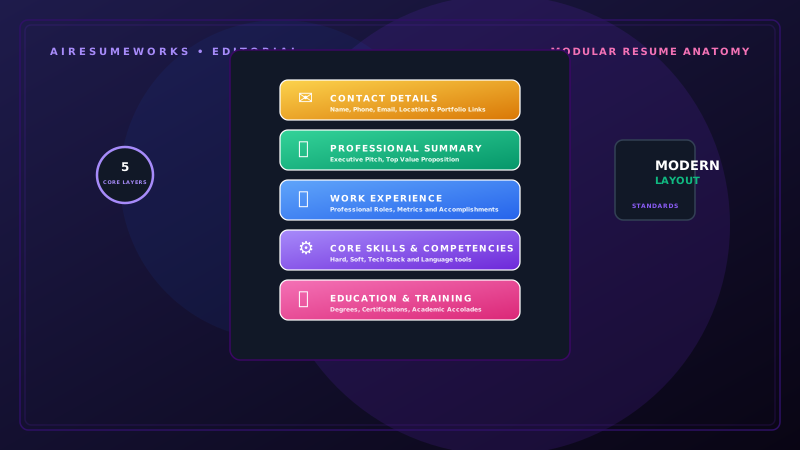
Most resumes do not need every possible section. For many job seekers, a strong basic structure is:
Contact Information
Professional Summary
Work Experience
Skills
Education
Additional sections can be added when they provide useful information. For example:
Experienced professional
Contact Information
Professional Summary
Work Experience
Skills
Certifications
Education
Recent graduate
Contact Information
Professional Summary or Objective
Education
Projects
Skills
Internship or Work Experience
Career changer
Contact Information
Professional Summary
Relevant Skills
Relevant Experience
Projects or Certifications
Education
The order should support your strongest qualifications.
Use Standard Section Headings
Simple section headings are usually the safest choice. Examples include:
Professional Summary
Work Experience
Education
Skills
Certifications
Projects
Avoid unnecessarily creative headings such as "My Journey" instead of Work Experience. Standard headings make the resume easier for both people and ATS software to understand.
Tailor Your Resume Sections to the Job
You do not have to use exactly the same resume for every application. A job description may emphasize particular qualifications. Your resume should make those qualifications easy to find.
For example, if a job requires project management experience, you might give greater emphasis to:
- Project management experience
- Relevant accomplishments
- Project management certifications
- Related skills
- Relevant projects
If another position emphasizes customer service, your resume may need to highlight:
- Customer interactions
- Problem resolution
- Communication
- Customer satisfaction
- Relevant software
- Sales or service results
The basic structure can remain the same while the content and emphasis change.
What Should You Leave Off Your Resume?
A modern resume usually does not need unnecessary personal information. Avoid including things such as:
- Social Security number
- Full street address
- Date of birth
- Marital status
- Number of children
- Personal hobbies unrelated to the position
- Irrelevant employment details
- Unprofessional email addresses
- False qualifications
You also do not need to include every job you have ever held if doing so makes the resume less relevant. Focus on information that helps demonstrate your qualifications for the position.
Keep ATS Compatibility in Mind
Applicant tracking systems are commonly used by employers to organize and screen applications. A complicated design can make information harder for an ATS to interpret.
For better compatibility:
- Use standard section headings
- Keep formatting relatively simple
- Use recognizable job titles
- Include relevant keywords naturally
- Avoid excessive graphics
- Avoid putting important information inside images
- Check that text can be selected and copied
- Use a logical reading order
An attractive resume does not need to be complicated. A clean structure with clear sections can be both professional and ATS-friendly.
Build a Master Resume
One useful strategy is to maintain a complete master resume containing your professional information. Your master resume might include:
Every relevant job
Accomplishments
Skills
Certifications
Education
Projects
Volunteer experience
Awards
Other useful information
You can then create a tailored version for each job application. This is usually more efficient than trying to remember every accomplishment each time you apply for a job.
The final resume should contain the sections and information most relevant to the position. A modern resume does not need to contain every possible section. It needs to contain the right sections for your experience and the job you want.
Start with the essentials, add sections that strengthen your qualifications, remove information that does not help your application, and organize everything so an employer can quickly see why you are a strong candidate.